Dear Uta Frith: Please Don’t Undo 20 Years of Progress

Mosaic of women

Mosaic of different people’s faces showing people of different races in a group.

I am not as old as Uta Frith.  I am not a researcher.  But I have been learning about autism since I met my first autistic pupils in 2003.  I’d already been teaching since 1991, and these two boys were the first diagnosed autistic that I had in my early years class.  One of them went on the next year to a special school and spoke his first words at the age of 27.  The other had 1:1 support through mainstream school and completed some GSCE’s.  But even then, I could see that each autistic person was different.

I went to work at an autism specialist school and did my post graduate autism training. I learned about the ‘triad of impairments’ and about Asperger’s Syndrome.  Both were ‘autism’, and in those days, it was still mostly boys.  In my school there were about 92 children.  Most of them were non or minimally verbal.  One or two could talk fluently about their favourite interests.  Only 8 were girls, and they were mainly non-verbal communicators.  We were early adopters of the sensory integration approaches, and I learned to listen to the sensory as well as non-verbal communication of my students.

I learned about the changes to the DSM-V in 2013.  I learned that autism and ADHD could now be diagnosed in the same person.   I was pleased to see the inclusion of sensory needs as part of the identification of autism.

I hated the extreme male-brain theory of SBC.  I thought about it.  I watched my students.  It didn’t make sense.

In 2014 I set up my own outreach service to schools.  There were a growing number of children in mainstream schools whose teachers needed to understand them.  I responded and listened to those children too.

And then emerged the awareness that girls had been missed.  The voices of autistic women being diagnosed after their children and the growing influence of the internet, opened a brave new world to us all.  I was very excited and threw myself to reading all the accounts and the research.  How wonderful it was to be there, in schools, helping them identify those girls who had been missed and supporting their journey through missed diagnosis and misdiagnosis.  The mental health issues started to emerge and the trauma of being ignored for so long.  And I rejoiced at the books and the websites and the research showing us how autistic people were being identified and understood better.  Understanding masking has helped so many autistic girls and boys.  Many schools wanted training, many more children were being helped and supported.

I learned about respectful language, ‘autistic’ and not ‘disorder’, and the emergence of the term ‘neurodivergence’.  I am still learning, still listening and still advocating for those young people I meet.

I knew we still had a long way to go.  The same happened with ADHD.  We are still a good few years behind our push to include everyone who has ADHD… and the missed girls who mask.  And as we journey on, we are realising how much the neurodivergences, well, diverge.  Multiple diagnoses of autism, ADHD, dyslexia etc are taking us on a new part of the journey.   It’s not making more work for schools.  It’s challenging the system to become a different system.  One where all children can learn and thrive in their preferred way of learning.

For all these years I’ve been listening, watching and learning.  I’ve learned that there are autistic people in my family and supported their journey too.  I’ve written books with the voices of autistic young people taking equal place alongside the researchers.  And now one of those early researchers is denying their diagnoses.  Uta Frith has given interviews saying autism is too widely applied.  She has come against those who can speak or articulate well and even taken a pot at our national treasure, Chris Packham.   The National Press playing a dangerous game and giving her airtime.

I have been learning about autism for over 20 years, and I will never stop learning.   I know the lives of autistic people are not easy, and the world is not a kind place for them.  Education is especially torturous.   I have spent 13 years supporting autistic and ADHD young people in education.  Despite amazing teachers and schools, the system is tough and unyielding.   I know because I see it every day.

That’s why I have to say please, please do NOT believe the lies being told by someone who does not seem up-to-date or relevant anymore.   Saying autism is not what it is 20 years ago is like saying the internet isn’t what it was 20 years ago.  I have been listening, reading and learning.  Researchers have been researching.  New understanding has moved us on.  Please Uta, do not destroy the progress we have made.  Young people’s lives can be destroyed by your words and the media storm it has created.  Too many adults have already lived with judgement and stigma that is now turning into self- acceptance.  And so many who really need help are waiting still.  The suicide and mental health numbers for autistic people are already too high.  We cannot go backwards.
Supporting Parents to choose the right school placement

Supporting Parents to choose the right school placement

A practical guide for SENCOs working with neurodivergent learners and their families.

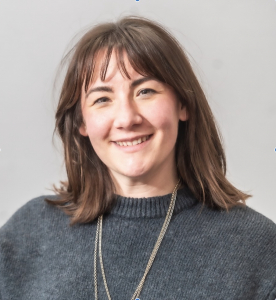
Picture of Katie, a white woman with brown mid length hair, smiling and wearing a grey jumper.

My name is Katie Fletcher and I am an associate specialist teacher for Reachout ASC.  As a qualified SENCO, I know the pivotal role in guiding families through one of the most significant decisions in a child’s educational journey: choosing the right placement at key transitions.

For parents of neurodivergent children, this process can feel complex, emotional, and high stakes. Your support can make the difference between families feeling overwhelmed and feeling informed, empowered, and heard.

Framing the process for Parents

When discussing key transitions, it can help to clearly explain that this is not simply a school move; it can be a legal process tied to a child’s EHCP.

Key points to reinforce with families:

  • The annual review in the Summer term of Year 5 or Year 6 Autumn term is critical for transition planning.
  • The local authority must issue a final EHCP naming a placement by 15 February (or 31 March for post-16).
  • Parents have a legal right to request a school placement.

Encouraging early engagement helps reduce last-minute pressure and supports more thoughtful decision-making.

Embedding a Neuro-affirming Approach

Families often receive mixed messages about what type of provision is “best.” As a SENCO, you can reframe this by focusing on fit rather than hierarchy.

Support parents to consider:

  • where their child feels safe and regulated.
  • environments that value difference rather than mask it.
  • provision that aligns with their child’s communication, sensory, and learning profile.

A neuro-affirming lens moves the conversation away from “can they cope in mainstream?” to “what environment enables them to thrive?”

 Supporting Parents to use the Local Offer

Many parents are unaware of how to navigate local authority resources. You can guide them to your Local Authority’s Local Offer:

Encourage parents to:

  • explore different types of provision (mainstream, units, special schools).
  • note which settings align with their child’s primary areas of need.
  • build an initial shortlist before visits.

You may also want to contextualise this information with your professional insight into local settings.

              Large school building with red and pale bricks.     

Helping Parents compare Mainstream and Specialist Provision

Parents can feel pressure—either toward mainstream inclusion or specialist provision. You can support balanced, needs-led decision-making.

Mainstream settings

Discuss:

  • Quality of SEN support and adaptability.
  • Peer environment and inclusion culture.
  • Capacity to deliver EHCP provision.

Specialist settings

Explore:

  • Level of specialism and therapeutic input.
  • Structure, predictability, and staffing ratios.
  • Peer group and communication compatibility.

Framing both options neutrally helps families feel less judged and more confident in their decision.

Preparing Parents for School visits

You can add significant value by helping parents go into visits with a clear lens.

Encourage them to look beyond surface impressions and consider:

  • Interactions between staff and pupils.
  • How distress and dysregulation are understood and supported.
  • Whether the environment feels calm, flexible, and respectful.

Where possible, offer to:

  • Suggest schools based on your knowledge, but don’t share unreliable opinions based on hearsay.
  • Support with arranging visits and making a bullet point plan of things to remember to look at or ask about.
  • Help interpret what parents observe.  This is best if you have visited some different provisions yourself, but again be neutral in your opinions.

Signposting to Support

Remind families they are not alone in this process. Key sources of support include:

  • Yourself as SENCO (ongoing guidance and interpretation).
  • Advice given by Reachout ASC as Specialist Teachers (evidence based understanding and knowledge).
  • Local SEND Team (placement decisions).
  • Local SENDIASS teams (independent advice and advocacy).
  • External professionals (EPs, SALT, OTs).

Clear signposting can reduce anxiety and improve engagement.

Key questions you can share with Parents

Providing parents with structured questions can build confidence and ensure visits are purposeful.

  • How does the school take a neuro-affirming approach?
  • How are individual differences recognised and supported?
  • What is the staff-to-pupil ratio?
  • How is EHCP provision delivered and monitored?
  • How are sensory needs supported?
  • What happens when a child becomes overwhelmed?
  • How does the school communicate with families?
  • How are pupils supported to express their needs?
  • What transition support is offered?
  • How do children normally travel to the setting?
  • Can this be personalised?

  Top Tips for SENCOs to Share with Parents

  • Start early – early conversations lead to better outcomes.
  • Encourage record-keeping – notes from visits and meetings are invaluable.
  • Centre the child’s voice – in whatever form that takes.
  • Focus on needs, not type of school.
  • Visit multiple settings to enable meaningful comparison.
  • Promote support services like SENDIASS.
  • Reinforce legal rights around school preference and appeals.
  • Encourage parental confidence – they know their child best.

By offering clear information, a neuro-affirming perspective, and practical tools, SENCOs can empower families to make informed, confident decisions about school placement—ensuring each child moves into a setting where they are understood, supported, and able to thrive.

Katie Flectcher is one of our associate specialist teachers at Reachout ASC and supports Schools, SENCOs and pupils with all aspects of SEND support. Contact her via office@reachoutasc.com

How to help my autistic child listen when I ask them to do something

How to help my autistic child listen when I ask them to do something

  • Start with your child’s name

Even if you are looking at your child, or sitting next to them, they may not necessarily realise that you are talking to them.  Your child may not understand that you mean them if you use words such as ‘we, you,’ For example, ‘Ok, we need to get ready’. ‘You need to sit down, it’s dinner time’. These words are too abstract, and can be very confusing which is why your child may completely ignore you. So, start with their name and then pause.

  • Don’t insist on eye contact

Eye contact can be painful for some children. You know your child best, if they regularly give either fleeting eye contact, or no eye contact at all, just accept that they can pay attention to what you say, without looking at you.

  • Say one thing at a time

This sounds so simple! It is, it’s just really hard to remember, especially in the beginning and other times, like when you are in a hurry and when you have a thousand and one other things on your mind. With practice, this honestly gets easier.  Tell your child specifically what you want them to do, as far as possible in just one word. For example, ‘Noah, coat on.’ (You don’t necessarily have to say ‘coat on’ you could just say, ‘Noah, coat’). This way round, which is much more effective than, ‘Put your coat on Noah.’

Ideas to support you today

  • Pause before repeating yourself.
    After you say your child’s name and the instruction, give them a few extra seconds to process. What feels like a long pause to us is often just enough thinking time for them.
  • Use visuals where possible.
    Pointing, showing the object, or using a simple picture can help your child understand without extra words. For example, hold up the coat while saying, “Noah, coat.”
  • Reduce background noise and distractions.
    Turn off the TV, music, or tablets before giving instructions. Less sensory input makes it easier for your child to hear and process your words.
  • Keep your voice calm and neutral.
    A steady, gentle tone is easier to process than raised voices or lots of emotion, even when you’re feeling rushed or stressed.
  • Acknowledge effort, not just completion.
    Notice and name when your child tries, even if it’s not perfect: “You picked up your coat. Well done for listening.” This builds confidence and trust.
  • Build routines around common requests.
    Doing things in the same order each day (coat, shoes, bag) reduces how much listening is needed because your child knows what comes next.
  • Be kind to yourself.
    Some days will be harder than others. If it doesn’t work every time, that’s okay. You’re learning together, and progress is not always linear.

Understanding ADHD in the Classroom: Moving Beyond “Bad Behaviour”


A teacher sitting at the side of a pupil helping them wit their work.

For many years, Attention Deficit Hyperactivity Disorder (ADHD) has been misunderstood in schools. Too often, children and young people with ADHD were labelled as disruptive, lazy, or poorly behaved. But our modern understanding tells a very different story. ADHD is not about a child choosing to misbehave—it is about differences in how the brain regulates attention, emotions, and executive functions.

As teachers, we are in a powerful position to shift the narrative. Instead of seeing ADHD through the lens of ‘naughty’ behaviour, we can see it as a matter of understanding and support. By reframing our approach, we create classrooms where students with ADHD feel valued, capable, and motivated to learn.

 “ADHD clearly appears to be a problem of willpower failure, but it is actually a problem with the interacting dynamics of emotion, working memory, and the chemistry of the brain.”  Thomas E. Brown

Read more

My experience of having a teaching assistant throughout my school years: An autistic adult’s perspective.

By Josh Collins: Our Newsletter writer at Reachout ASC

September 2024

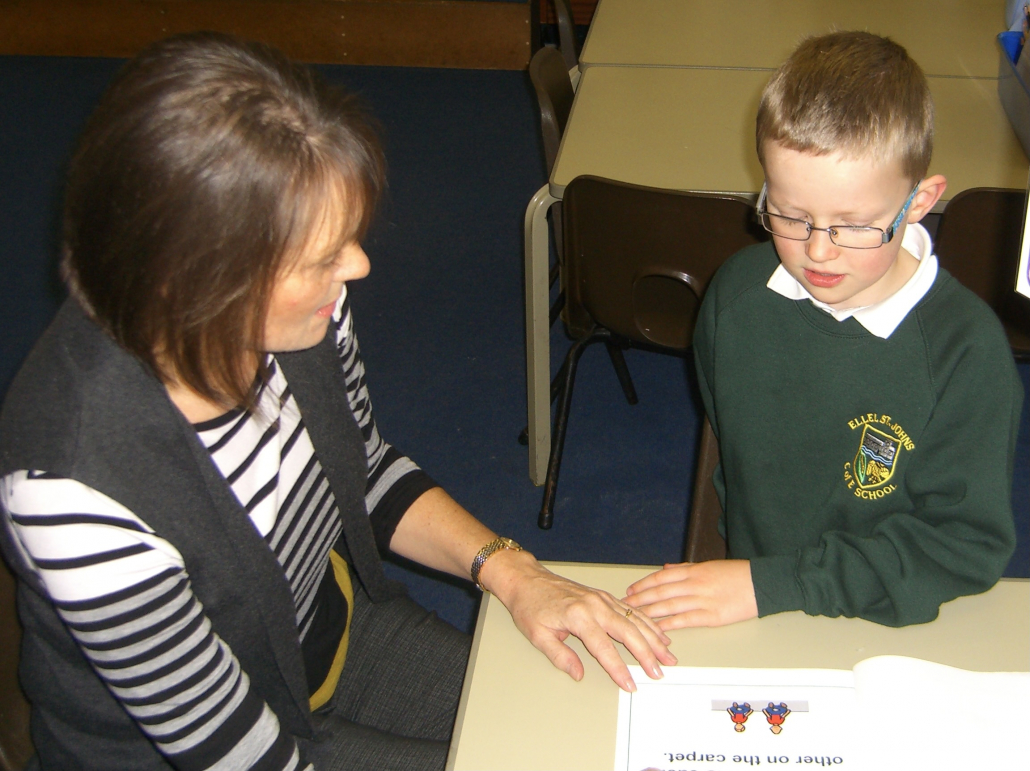
A white, blond haired woman sitting at a school table next to a white, brown haired boy wearing glasses. There are sensory toys on the table.

Teaching Assistants can work 1:1 with some autistic children in schools.

 From my first day of reception to the final question on my third physics paper in June of 2016, I have had a teaching assistant sat beside me, or with me, in some capacity. For many across the country, a teaching assistant is going to be one of the people they spend the most time with.  I was not a unique case; this was also true for me.

Over my time, I have developed strong emotional bonds with teaching assistants. Other times, I have had the opposite; having either silently or very verbally wishing to have someone else in their place. Regardless of how I feel about them, they have all bagsied a plot of land in my memory and summative ideal of a teaching assistant.

Read more

How do we support children with autism and complex needs in the early years?

three young children following each other down a grassy path. You only seethe back of them.

Are you an Early Years teacher or teaching assistant?

Do you have children in your class that you are struggling to engage or understand their needs?  Do you think they might be autistic or have other SEND needs that you are not qualified to diagnose?

Are you struggling with the slow pace of getting help and assessments for some children?  Are there not enough hours in the day to work out how to adapt your teaching for such a variety of needs?

We have been privileged to work alongside many EYS teachers over the years and here myself and Alison Pettitt, our EYS autism specialist discuss some of the ways that every non-specialist teacher can build in teaching and learning activities for children who may be autistic.

Read more

Can Social Stories really help autistic young people?

Teaching assistant sharing a story with a boy pupil in a green jumper.

By Lynn McCann author of Stories that Explain

*Social Stories are a Trademark of Carol Gray https://carolgraysocialstories.com


As an autism specialist teacher, I have been writing social stories for over 15 years. But I’m the first to admit that social stories can be ineffective, damaging and even dangerous.

The trouble is that many people have heard about Social Stories and mistakenly think they are a tool to sort out misbehaviour, or to get a child to comply with something. These sort of Social Stories are ineffective because they are badly written with no reference to the actual structure and rules created by Carol Gray in the early 1990s for very good reasons.  At best you might have wasted your time and the child and the staff end up feeling that Social Stories are not worth using a tool. Sadly, badly written social stories can also seriously damage a child’s self-esteem or put them in danger.  The relationship with the adults around them can be damaged through them insisting that the child complies with something that is actually very difficult for them to do. The adults’ wrong assumptions can affect the child’s mental health and make them very vulnerable to exploitation. This is a serious matter.

I would always be fair to parents and teaching staff as they are often told by educational psychologists, advisors, autism trainers that they should use Social Stories without being given any training in how to write or even choose a good one from the millions of templates there are out on the internet. Wanting to help, people might search the internet and copy something that they’ve seen online and hope that it will help the child.  Often, what they end up with is a script that breaks all the rules of how to write a good Social Story.


These are some of the things that make a script not a Social Story

  • Only talking about negative things;
  • Using language such as must, always, you need to, you will, you must, you have to
  • Assuming how someone will feel;
  • A list of rules or punishments;
  • What you must do to please somewhere else;
  • Explaining how your actions hurt other people and blaming the person for getting it wrong;
  • Insisting that the person understands your point of view;
  • Insisting an autistic person behave in a typical way or trying to make them stop being themselves.


A Social Story works really well if first we understand the experience or the issue from the autistic person’s  perspective. Then we write the story in a way that acknowledges this. We use carefully chosen words to explain what we would like to help the person understand in a way that makes sense to them.  Carol Gray’s rules on sentence types allow us to do this. Following her guidance means that we can write good Social Stories consistently and be more certain that there are helpful resource, and not a waste of time.

I have written Social Stories to help autistic children and young people understand many different social situations that they found tricky or confusing. I’ve written stories that help autistic children manage many different anxieties and prepare for new experiences. The topics I have written them about, range from “what happens to poo when it goes down the toilet”, to “why we can use other people’s ideas in our writing and how that helps us know what to write”. I have written about death, loss and fears as well as celebrations, affirmations and how awesomely autistic someone is. You can write Social Stories for very young children, for those who do not use verbal language or cannot read, right through to those who can discuss and consume very complex explanations when they are written in a way that makes sense to them.  I personally write most of my Social Stories with teenagers who are trying to understand the complex world around them.  We have covered politics, gender, revision, relationships, sometimes with a huge dose of humour as we seek to reassure and celebrate the young person’s life and help them navigate through school and beyond.  Their views and aspirations are celebrated and often by this age, we write the account together so it is for them and with them.

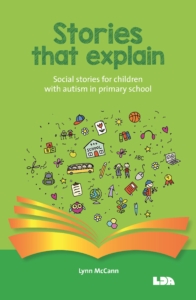
In my book, Stories that Explain

https://www.ldalearning.com/product/communication-and-interaction/autistic-spectrum-condition/teaching-resources/stories-that-explain/admt14158

I shared over 60 social story templates for primary age children, that could be edited to support common situations that we have found our autistic young people have had to deal with over the years.  Each one takes account of the sensory and communication differences as well as explaining the situation to help them understand it better. We write coaching sentences which helps a child make choices about what they can do in each of those situations.

I’m really passionate about teaching other people how to write good Social Stories… and we regularly put courses on to teach people to do just that.  Keep an eye on our UPCOMING TRAINING PAGE for dates, or invite me to do training for your school, group or organisation.   The course is open to everyone, at a reasonable cost and in the three hours I’ll take you through the rules, show you examples and then you’ll have a go at writing a story with my tutelage.  I intend to give you all the skills you need to be able to go away and write your own social stories for the children, young people and even adults that you support.

This course is suitable for parents, school staff, and volunteers and carers. We can do it online or in person, so that people from anywhere can join us, and you will also receive a pack of story examples, the handout from the training and some helpful tip sheets so that you can continue to write the best Social Stories.

(Social Stories can be written for children, young people and adults so whichever service or age of person you work with, this course is for you).

New Articles with practical advice

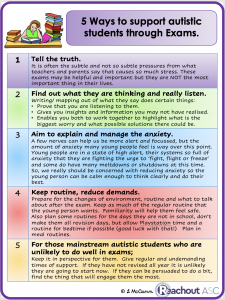
summary of the 5 points in a poster

We’ve written some new articles and here are some of our favourites aimed at secondary teachers: 

  • Girls and autism  

  • Preparing and autism friendly secondary classroom  

  • 5 ways to support autistic students through exams 

  • •What is Revision?’   booklet 

  • What makes transition to secondary school work 

  • Autism and homework 

  • Autism and behaviour in secondary schools 

  • Autism and group interactions  

New Collaborations for the Reachout ASC team

We’ve been chatting to all kinds of people who share our passion for autistic young people, and we currently have projects on-going with:

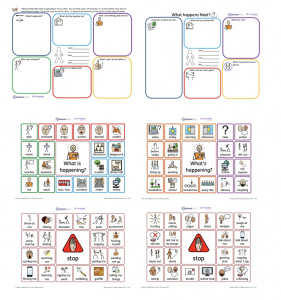
two blank maps with questions to ask a child, and four vocabulary mats with Widgit symbols

  1. Kidscape – Anti-bullying charity

Check out our autism communication mat, parents booklet and social stories that we have created with Kidscape, with Widgit.com symbols.

https://www.kidscape.org.uk/advice/advice-for-parents-and-carers/what-is-bullying/autistic-children-and-bullying/

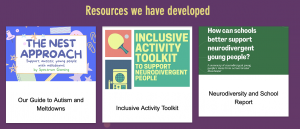
picture of three booklets. 1. The NEST approach for meltdowns, 2. Inclusive Activity Toolkit, 3. Report for schools

2.  Spectrum Gaming

We have loved working alongside the gang at Spectrum Gaming to support the development of their resources. Take a look what they have produced with autistic young people:

https://www.spectrumgaming.net/advocacy

3. The PDA Society

Lynn has been on the Education Committee of the PDA Society and has contributed to these new PDA support leaflets now on the Twinkl website:

https://www.twinkl.co.uk/blog/teaching-learners-with-a-pda-profile


And there’s more to come in 2023!

Lego based therapy courses.

Our Lego Based Therapy Courses are now available online

We have developing an online version of our Lego Based Therapy training which works best be for 2 adults from the same setting.  In the afternoon you would be working with 3 children in your school for 45 minutes.   For full details (and you can still take part if you are unable to work with children) please email us.  Look out for course dates on our UPCOMING TRAINING PAGE. 


Read more